
Oklahoma's 10 Most Wanted Reported 17 Captures
The Oklahoma Attorney General counted 17 captures credited to its 10 Most Wanted campaign by May 14, 2026. That number is small. It is an aggregate program figure. The dated Oklahoma OAG update puts the tally in context, but it says nothing about any individual case. It is not a count of every Oklahoma warrant cleared. One campaign result cannot change the status of another person's warrant either, and it offers no statewide clearance check of any kind. Oklahoma's court orders stay with the issuing court. Local law enforcement keeps its own service record. For a specific matter, use the county or city court route. The figure proves the campaign's own work, nothing more. It does not show that a public list covers every county, every municipal court, or every active court order in Oklahoma. No statewide public warrant search exists. And a capture count is not a count of all arrests on court warrants. The Attorney General's update gives no denominator for outstanding Oklahoma warrants and cannot tell you whether particular county or city orders appear anywhere. Treat the 17 as a dated program result, not as statewide coverage or a measure of any one case.
How Oklahoma Runs Its Most Wanted List
The Oklahoma Attorney General's 10 Most Wanted program launched in September 2024 as a selective fugitive campaign. Agencies nominate cases. The OAG then picks a limited set for public attention based on serious public-safety concerns. The goal is tips and apprehension, not a publishing of every active warrant in Oklahoma. The Attorney General describes it as a partnership spanning federal, tribal, state, county, and local law enforcement. The roster is updated periodically as cases change, though Oklahoma states no fixed refresh interval and makes no claim of complete county coverage. The official Oklahoma Attorney General's Most Wanted page is the authoritative public source for current campaign information. Go there for names, photos, and roster entries rather than expecting copies elsewhere. Authority over each underlying case does not move. The issuing court and the local prosecutor in Oklahoma keep control no matter who appears on the campaign list, and selection never shifts a warrant to the OAG. Case status and service questions still go to the named local agencies. The OAG page is simply the public route for its selected program. No complete public roster exists, and no automatic refresh cadence is stated.
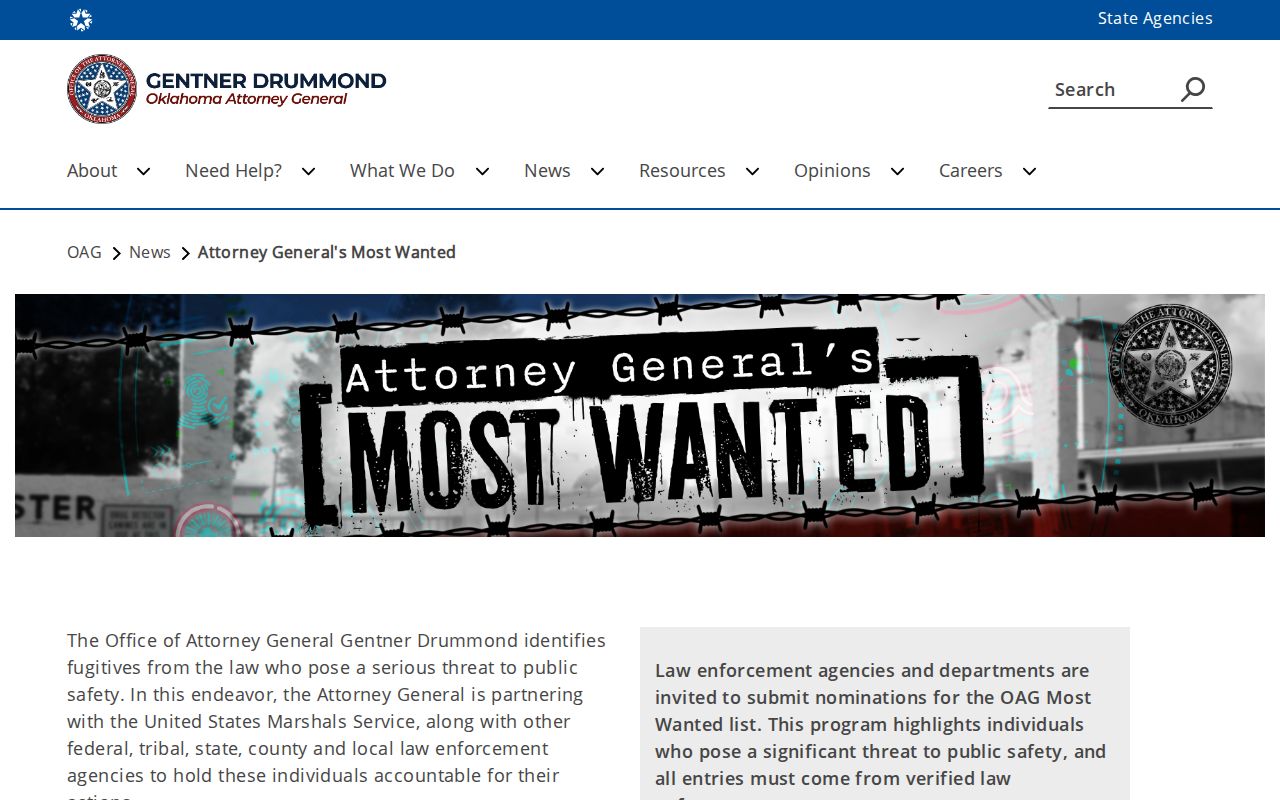
The Oklahoma campaign image shows program information only. Open the official Oklahoma page for current details, and never treat campaign membership as a complete warrant result.
Oklahoma Attorney General 10 Most Wanted
The official Oklahoma campaign page describes the curated program and its public tip channel. It is not a comprehensive Oklahoma warrant search.
Note: Oklahoma's public Most Wanted campaign is a selected outreach program, and the issuing court still controls its own warrant and case record.
Oklahoma's Most Wanted Nomination Is Restricted
Oklahoma's nomination page exists for law-enforcement agencies, not for the public. It is not a form to name or investigate someone. Instead, it explains how an agency may submit an eligible case to the Attorney General's selection process. Members of the public should not try to add a person to the campaign. Tips, though, are welcome through the program's published channel. For current submission instructions, open the official Oklahoma law-enforcement nomination page. Do not confuse the two systems that live near each other. A nomination to this Oklahoma campaign is a selective process with no public online application attached. The statutory OLETS feed is something else entirely: restricted agency identification data. Neither one is a public Oklahoma warrant lookup, so treat both accordingly.
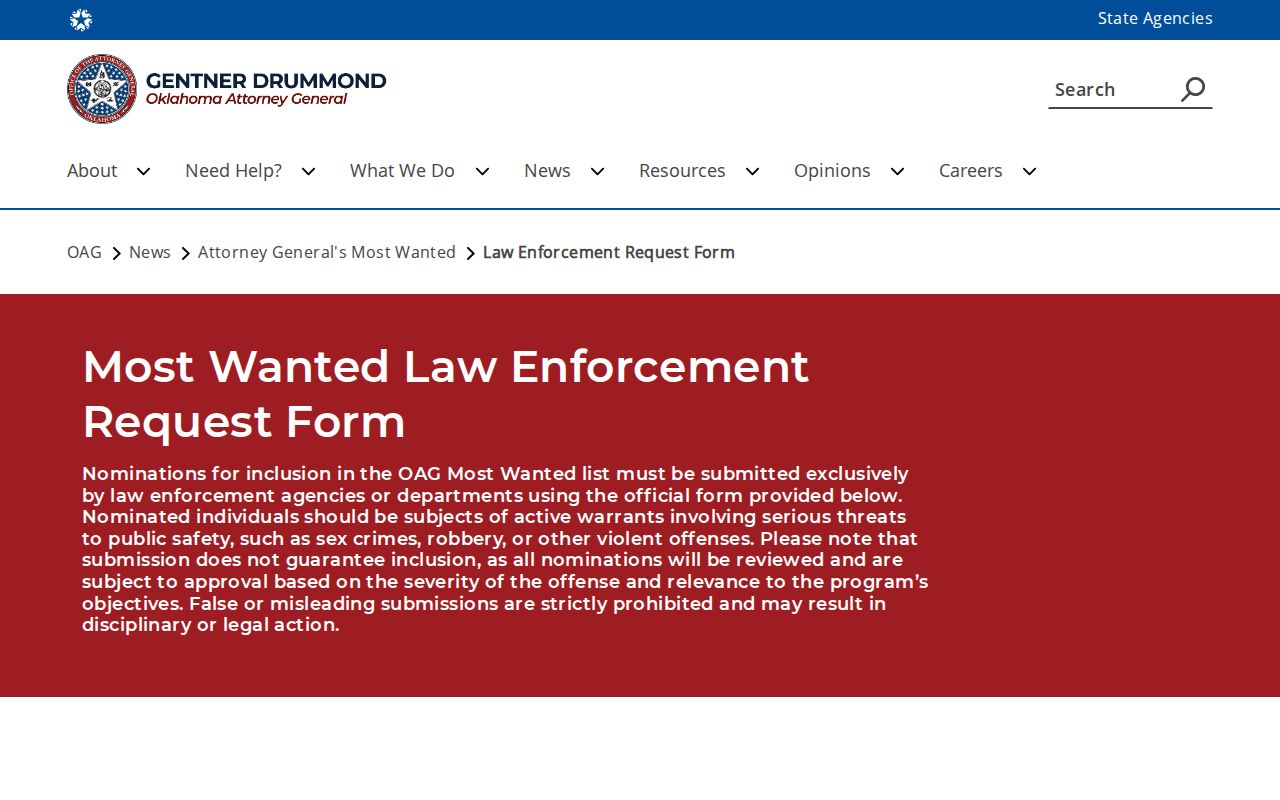
The Oklahoma image shows the agency nomination route, not a roster of names, cases, or active Oklahoma warrants. It is not a public warrant lookup.
Statewide or County Most Wanted in Oklahoma
Oklahoma's OAG campaign and local sheriff pages serve different purposes. The state program is selective and curated. Each county sheriff controls any local published list, and publication practices vary from county to county, so neither source amounts to a complete statewide warrant register.
| Feature | Oklahoma OAG Campaign | County Sheriff Page in Oklahoma |
|---|---|---|
| Run by | Oklahoma Attorney General | Each Oklahoma county sheriff, where it publishes a list |
| Scope | Selected law-enforcement nominations | Local agency's own published selection |
| What absence means | Does not establish that a person has no warrant | Does not cover other county or city courts |
| Where to find it | Official Oklahoma OAG campaign page | Open Browse Counties and follow the local sheriff's official site. |
For local Oklahoma published material, open Browse Counties and follow the relevant sheriff's official page. Keep expectations realistic. The directory does not imply that every sheriff maintains an Oklahoma Most Wanted roster. The OAG and local sheriff pages also change independently of each other, so a county page may publish selected fugitive information without representing all court warrants. A county with no visible list may still have active warrants. The directory identifies local channels only. It cannot guarantee that a sheriff posts a list or refreshes one on a fixed schedule. Note: the Oklahoma county directory routes readers to local sources but cannot confirm whether each sheriff publishes a Most Wanted list.
Oklahoma Fugitive Task Forces Link Agencies
Oklahoma hunts fugitives through teamwork rather than through one office. Federal, state, tribal, and local agencies all take part. The Department of Public Safety signed a task-force memorandum with the U.S. Marshals Service, effective December 8, 2025, and that agreement covers investigative and apprehension cooperation. It did not launch a public database. It also left unchanged which court issued a warrant. The U.S. Marshals Service posts task-force and federal-district contact information for Oklahoma and other districts. Those teams coordinate enforcement, not public name searches. A state or local order still routes to its issuing court and its serving office, while a federal matter follows the federal district and the U.S. Marshals route. The DPS memorandum shows the agreement itself. The U.S. Marshals district directory lists the offices. Oklahoma's federal districts divide federal court jurisdiction, yet none of this indexes every Oklahoma state or city warrant, merges court records, or builds a public path for searching an active order.
Sending an Oklahoma Tip Safely
Tips about an Oklahoma OAG campaign case go through the contact route on the official program page. The current Oklahoma OAG page lists the tip phone as 405-343-8107. The email is OKMostWanted@oag.ok.gov. Those Oklahoma channels take relevant tips only, not questions about whether a person has a warrant. The nomination form is restricted to law enforcement.
- Use the contact route on the official Oklahoma OAG Most Wanted page for a program tip.
- Share only relevant information with law enforcement. Ask the official program how it handles anonymity and any reward terms.
- Do not approach, follow, or try to detain anyone. Call 911 for an immediate emergency.
Key point: Send a tip only through the official law-enforcement channel. Never approach, follow, or attempt to detain a person named in a public campaign.
The Oklahoma contact route exists for relevant information about a selected campaign case, not for personal warrant inquiries. Public material promises neither anonymity nor a reply. Skip public forums. Do not post a tip or identity details there; use only the official Oklahoma channel.
Oklahoma Most Wanted Rewards Vary by Case
Oklahoma's campaign mentions rewards, but payment is never automatic. The OAG's January 9, 2025 program update described offers ranging from $1,000 to $10,000 for information leading directly to an arrest. That dated range is not a promise for every current case. Current rewards depend on official terms for each case. So do the conditions. An Oklahoma reward offer is case-specific, not an open-ended statewide bounty. It pays only for qualifying information. It pays no court fees. Reward details say nothing about a warrant's legal status or bond, so keep the two ideas apart. The public role is to report relevant information safely through the official channel. Your own case belongs on the court and attorney route described below, not the tip program. The underlying Oklahoma warrant still has its own bond, appearance, and recall terms. Rewards are no substitute for court process. Note: An Oklahoma campaign reward does not set bond or recall terms for an Oklahoma warrant.
Oklahoma Most Wanted or Active Warrant
Oklahoma's Most Wanted campaign is a curated group of selected cases. It is not a warrant register. An active Oklahoma warrant is a court order and can exist without ever appearing on that list, and Oklahoma has no public statewide active-warrant search. The campaign cannot answer whether any other warrant exists. See Active Warrant Search for a fuller explanation of Oklahoma's public-source limits. A hit needs confirmation with the official source and the relevant court. A no-hit is not clearance. The order may sit in an Oklahoma District Court or a city Municipal Court. Route a state or city case through Browse Counties to reach the local court and the sheriff or police office. A public docket may show a case event. It may not confirm that an active Oklahoma warrant remains. The OLETS warrant-identification feed is restricted, and the curated campaign is no statewide interface. Contact the issuing court, then verify service details with the local sheriff or police.
An Oklahoma List No-Hit Is Not Clearance
The Oklahoma OAG page is a selected campaign, not an all-warrant query. A name missing from Oklahoma's list may still carry a county or municipal warrant, and a name match needs identity and case confirmation through official channels. OSCN and ODCR are docket tools. Each has court-specific scope. Neither is a live statewide warrant register. For an Oklahoma matter, identify the issuing court from the case papers. Ask its clerk for current status. Then contact the serving sheriff or city police office about its own enforcement record. Never substitute a campaign or docket for that confirmation. Public access in Oklahoma can depend on the type of record and the office holding it. If you need a copy, ask the court or enforcement agency which record it holds. Ask whether any exception applies. A no-hit on a public page is not an official closure notice.
Finding Your Own Name on an Oklahoma List
Seen your name on the Oklahoma OAG page, or a relative's? Do not read court status from the campaign alone. An Oklahoma attorney can review the case, confirm the issuing court and the current order, and advise on a safe appearance or surrender. For state or city records, use Browse Counties. It points to the correct local route.
Important: Ask a qualified attorney to confirm the case and contact the issuing court before acting on a possible warrant or campaign listing.
If the worry is about you or an Oklahoma relative, gather the notice, the case number, and any court correspondence in one place. Call the clerk next. The clerk can confirm what the court record shows, while the serving agency can tell you whether a warrant is still active. A lawyer can then arrange a safe next step. That beats trusting a campaign page. Note: Confirm an Oklahoma warrant with the issuing court and serving agency even when a state campaign lists a related case.