
Oklahoma Municipal Warrants Start in City Court
Oklahoma municipal warrants grow out of a local court case. Title 11 governs Oklahoma city courts and their ordinance process, and a municipal judge signs the warrant while the city clerk keeps the file. For a picture of the structure, the FY2025 Oklahoma court-system diagram counted 352 municipal courts not of record plus 2 municipal criminal courts of record. Those numbers describe how Oklahoma organizes its courts. They do not say how many cities offer a warrant search. Each city's file stays with that venue, so an Oklahoma ticket heard in city court does not turn into a District Court case just because the driver lives elsewhere. Read the court name printed on the notice, then ask that clerk. On the county side, Oklahoma runs 77 District Courts across 26 judicial districts, and the annual report counts municipal courts separately. A sheriff who serves a city warrant does not convert it into a county warrant. Case ownership follows the issuing court, and the serving agency may hold a second record covering only service.
How Municipal Warrants Work in Oklahoma
An Oklahoma Municipal Court hears city-ordinance matters, including local traffic cases. When a judge there issues a warrant, the order belongs to that one municipal case. The city's court or police warrant office can usually speak to the record and service status. A county sheriff may serve some process, but the sheriff does not replace the city court as the home of the case. Oklahoma has no county justice-of-the-peace tier. "Magistrate" names a judicial role in certain procedures, while the ordinary county trial venue is District Court. Municipal Court and Municipal Court of Record form the local layer that handles city cases. A local file may use that court's own warrant term, too. "Capias" is not a general Oklahoma label. The venue question is what matters: ask the municipal clerk. Note: An Oklahoma municipal warrant stays attached to the city case even when a county sheriff or another peace officer serves it.
City Process in Oklahoma Has Local Service
Oklahoma Title 11 §§27-113 and 27-115 set the rules for municipal complaints, judge approval, and service. A city chief of police, a county sheriff, or another peace officer may serve eligible municipal process. Nothing in the statute creates a statewide municipal warrant unit, so ask the issuing city which office handles its records and service questions. When a county sheriff serves a city warrant under that provision, the municipality pays a statutory service amount into the sheriff's fee account. That charge falls on the city, not a general defendant warrant fee. The Oklahoma court still controls the case, any bond term, and the order needed to recall process. You can read the official Title 11 text for the governing provisions. The practical route starts with the city clerk and may extend to whichever agency the warrant names for service. A sheriff can confirm its own execution record but cannot replace the Municipal Court or recall the city's order. Ask the Oklahoma court what written disposition it will issue and who receives it.
Municipal vs County Warrants in Oklahoma
Oklahoma keeps city and county cases in different court systems. The issuing venue decides who holds the file, whether an online lookup exists, and which official can confirm a recall. A Municipal Court matter should not be routed only through a county sheriff search. For a traffic citation in a city court, see Traffic Warrants.
| Feature | Municipal Court Warrant in Oklahoma | Oklahoma District Court Warrant |
|---|---|---|
| Issuing court | Oklahoma Municipal Court for the city case | Oklahoma District Court for the county case |
| Typical matter | Oklahoma city ordinances and municipal traffic cases | Oklahoma District criminal matters and other cases assigned by law |
| Case file | Oklahoma Municipal Court clerk keeps the local file | Oklahoma District Court Clerk keeps the county case file |
| Service route | Oklahoma city police, sheriff, or other authorized peace officer | Oklahoma county sheriff or another authorized peace officer |
| Public search | Oklahoma city-specific; no unified state index | Oklahoma docket availability varies; not live warrant confirmation |
Oklahoma Municipal Warrant Searches Have Local Scope
The Tulsa Police warrant search is one Oklahoma city example. Its public form matches a first and last name against Tulsa Municipal Court warrants, nothing more. It does not search Oklahoma District Court or other municipal courts. The page also warns that results can lag, since city process issues and cancels at any time while listed updates happen through the workweek. Treat it as a local Oklahoma interface, not a statewide standard, and use it only for the court that portal names. A blank result elsewhere, or a name match without case confirmation, cannot settle a person's status across Oklahoma. The companion Oklahoma Municipal Court page carries the city's own records and warrant instructions for its cases. The Tulsa city warrant search form opens with narrow name fields, which shows just how tight this local channel is.
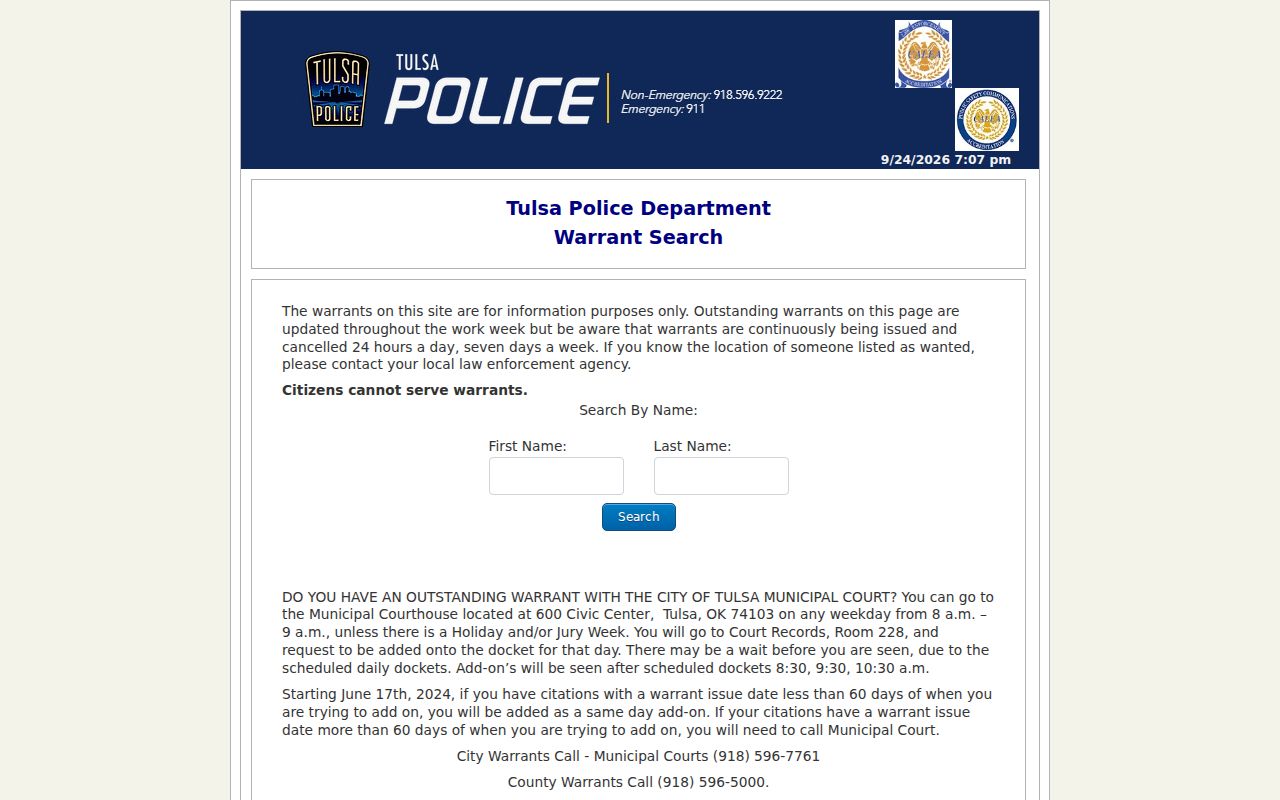
Oklahoma has no single municipal-warrant search that covers every city court. What you see from Tulsa is one city's tool, built for Tulsa cases alone. A blank search screen proves nothing about other cities, and a clean result from one clerk never rules out an order elsewhere in Oklahoma. Even a correct name can pull up a stranger with a similar spelling, or miss a warrant signed the same week. The Municipal Court that issued the order is the only office that can confirm what the case file actually says. Note: Tulsa's blank Oklahoma warrant form shows one local search design; other cities may use different fields or no public form at all.
Oklahoma Municipal Warrant Checks
Oklahoma has no public statewide warrant lookup. The restricted OLETS, ODIS, and NCIC systems are for agencies, not the public. OSCN and ODCR are open Oklahoma court-docket tools, but participation varies by county and neither one is a complete active-warrant register. OSCN's traffic citation search excludes municipal citations. Each route covers only its own records, so a city court, police department, sheriff, or records request answers only for what that office holds.
- Read the Oklahoma city, case number, and court from the citation, summons, or court notice.
- Search the issuing city's official Municipal Court or police page if it offers a warrant or case lookup.
- Open Browse Counties to reach local court and sheriff information when the city route is unclear. City ordinances still belong to the named Municipal Court.
- Call the municipal clerk or warrant office to confirm the order, bond or appearance requirement, and how the judge's recall is recorded. Contact the sheriff if it handles service or custody.
- If an Oklahoma record is not posted, send a focused request to the custodian under the Oklahoma Open Records Act. Section 24A.8 addresses warrant dispositions held by law enforcement, subject to exemptions and orders.
The Oklahoma Open Records Act, 51 O.S. §24A.8, covers law-enforcement records and the disposition of warrants an agency holds, within statutory limits and exceptions. It does not open every investigation or make a docket complete. Name the Oklahoma city, the case, and the record custodian, then ask about copy charges or protected fields before you rely on what comes back.
Oklahoma Municipal Ticket Lookup Can Miss Warrants
A city ticket lookup can find a citation without telling you whether a warrant is active on it. Oklahoma City keeps these apart, with a separate municipal case lookup and a distinct warrant information page. The lookup itself warns that new matters may take three to five days to appear and payments at least 24 hours to update. Those clocks belong to that city's system. They are not statewide update times, and they say nothing about when a separate warrant order reaches a police or sheriff record. If an Oklahoma City page comes back blank or a payment has not shown up yet, call the court instead of assuming the matter is gone. An Oklahoma city case needs the issuing Municipal Court's own confirmation, even with a ticket portal available.
Oklahoma Municipal Warrants: What They Show
Oklahoma publishes no statewide municipal-warrant field schema. Each city record shows the case and status information its court keeps, and the visible fields and number formats differ from one municipality to the next. Give the clerk the case or citation number so the right file comes up fast. Then ask whether the judicial order is active and what the court wants done about it.
| Warrant or case number | No statewide format published Give the clerk any number printed on the citation or notice. |
|---|---|
| Person named | Confirm name and identity details with the issuing court; a similar name is not proof of a match. |
| Offense or ordinance | Ask which city-ordinance or municipal-traffic matter is tied to the order. |
| Issuing court | The specific Oklahoma Municipal Court that issued the order, not a statewide court desk. |
| Bond, fine, or appearance | Terms set by the court; ask what is currently required and accepted. |
| Status | Ask whether it is active, served, recalled, quashed, or otherwise resolved. |
An Oklahoma search result that lacks a bond, issue date, or disposition field is not proof the court holds no underlying order. Ask the clerk to check the official case record and explain whether the visible city portal is refreshed from that file. Note: A docket field may show a case event without proving that a Municipal Court warrant is still active in Oklahoma.
Oklahoma Cost Warrants Use Different Forms
Court-cost process in Oklahoma is a different animal from an ordinary city ticket warrant. Under 22 O.S. §983v3, the official municipal forms split cost warrants into two types: a cost arrest warrant and a cost cite-and-release warrant. The Oklahoma Court of Criminal Appeals Form 13.17e is the municipal cost arrest form, while Form 13.17g is the cite-and-release version. Both are blank Oklahoma court forms, not populated records for any person. The blank Form 13.17e shows the layout of the municipal cost arrest warrant.
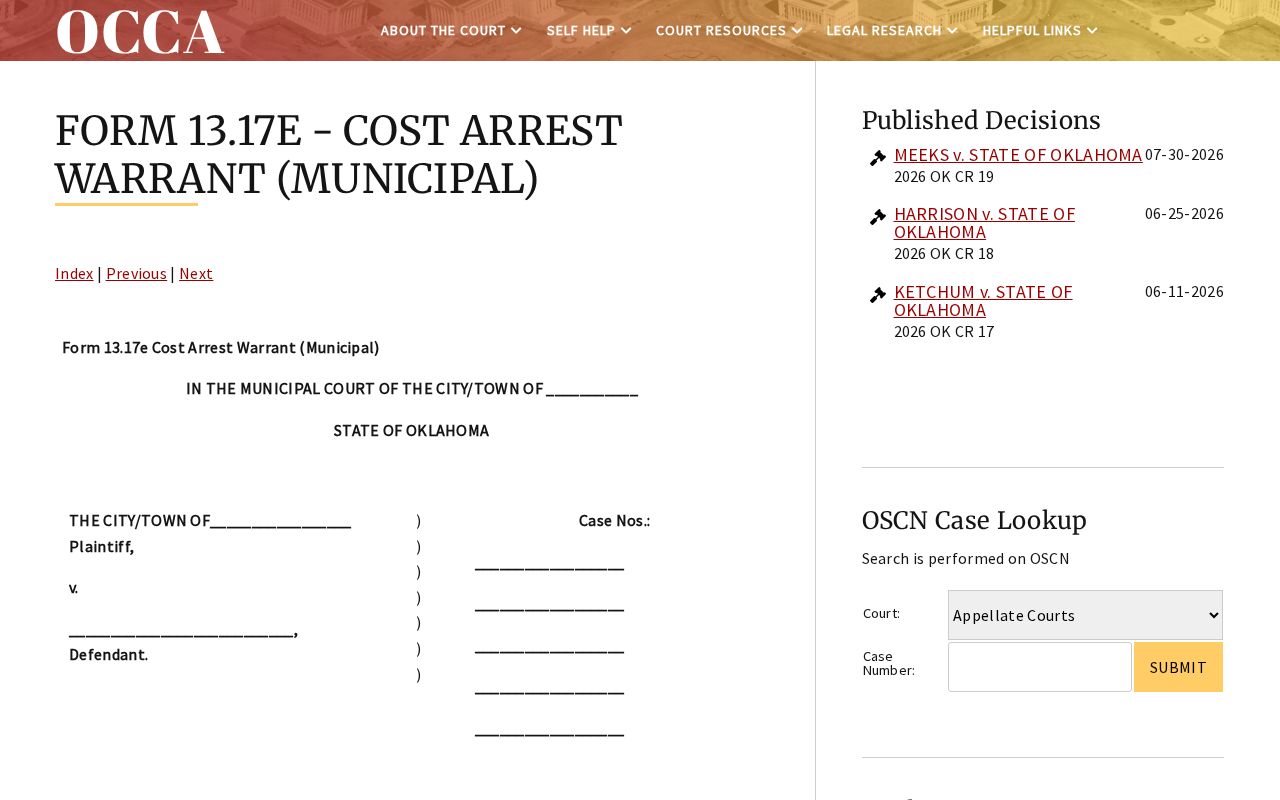
Seeing the form does not mean an Oklahoma court issued this process against anyone. The judge's order and case status must be checked with that city's clerk. The blank Form 13.17g shows the separate municipal cost cite-and-release process.
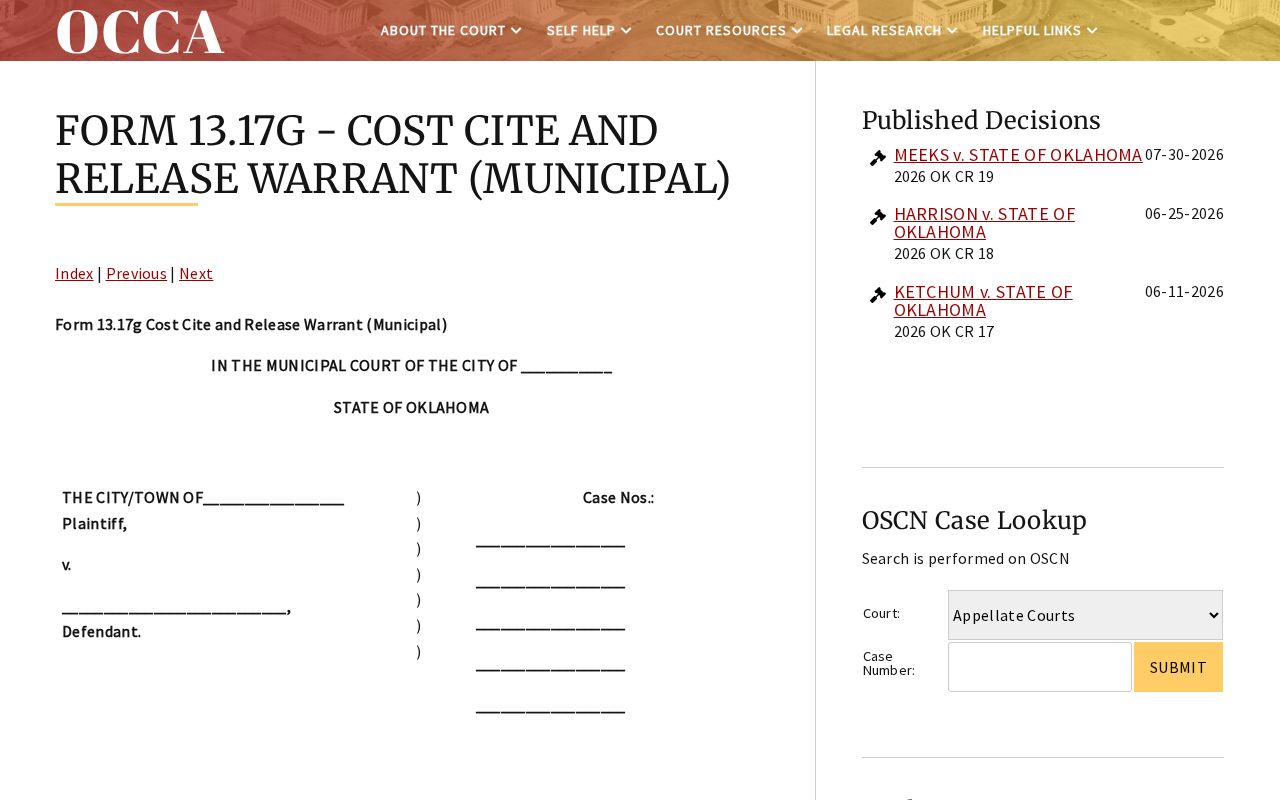
The cite-and-release form directs that a person not be arrested solely under that warrant and sets a report-to-clerk process instead. Ask the court which cost procedure, if any, applies to the case. Before assuming a ticket-payment screen resolves the warrant, look at the exact form and order in the city file for the Oklahoma cost case. The two official Oklahoma forms describe different procedures, and neither one is a person's populated record.
Clearing a Municipal Warrant in Oklahoma
The issuing Oklahoma city court decides how a warrant gets resolved. Depending on the case, that may mean paying the court amount, appearing before the judge, asking about a payment plan or ability-to-pay hearing, posting a court-approved bond, or requesting recall through counsel. One payment alone does not guarantee the Oklahoma municipal warrant order has been recalled. Confirm with the court before you assume it is done.
- Confirm the municipal case, warrant type, current status, and any bond or appearance term with the city clerk.
- Ask whether the judge requires an appearance, permits a payment plan, or will consider an ability-to-pay hearing.
- Arrange any bond only after confirming the accepted type and whether it secures release or also changes the warrant order.
- Request the written recall or disposition and ask which service agency receives it.
- For a traffic matter with a separate license suspension, follow up with the credential agency after the court reports compliance.
Caution: Confirm the current warrant and court instructions before paying or appearing; a city ticket balance alone does not establish that process has been recalled.
When an Oklahoma Municipal Court says process was recalled, ask whether the city police or sheriff received the update and whether a separate license report remains open. Keep a copy of the court disposition with the payment or bond receipt. Note: Keep the Oklahoma court's written warrant recall with any payment receipt so the municipal clerk and the serving office can confirm the same outcome.