
Outstanding Warrants in Oklahoma
In Oklahoma, a warrant is "active" or "outstanding" until a record shows it was served, recalled, or cleared. That label only speaks for the record you checked. No public list spans all 77 counties, the municipal courts, every warrant type, and every agency. A sheriff's search covers that office. A city search covers its Municipal Court. A docket is a case record, not a live statewide status. Oklahoma's law-enforcement link is closed to the public: under 47 O.S. §2-124.1, the courts' administrative office sends arrest-warrant identification data to DPS for authorized OLETS users, and the public cannot query it. The statute names no covered warrant types or per-record update timing, so confirm active status with the Oklahoma court that issued the order. To find the right local office, start from the case location and use the county directory. A city ordinance case may require the city's court and police contacts even when the person lives elsewhere.
Oklahoma Has No All-County Active-Warrant List
No Oklahoma website offers a public name-and-date-of-birth search of every active warrant. OSCN and ODCR carry some court dockets, sheriff pages show local records, and the Attorney General's 10 Most Wanted campaign is selective. Each source answers a different question. None certifies there is no warrant statewide. OLETS, OSBI's ODIS RMS, and NCIC are restricted criminal-justice systems, not hidden Oklahoma public portals. Public materials give no county participation map or shared query fields. A docket's presence does not prove a warrant is in any particular feed. A no-hit can reflect a different Oklahoma venue, limited docket coverage, a restricted or new order, or a name mismatch. A hit may belong to a namesake. Identify the case, then verify with the court and the serving agency.
The Oklahoma Active-Warrant Picture
Oklahoma records split by custodian. The court keeps the case and the order; sheriffs and city police may hold service records. The courts' administrative office sends computerized arrest-warrant identification data to DPS for restricted OLETS users. OSCN and ODCR expose available dockets. Service Oklahoma receives separate court reports for certain traffic FTA license suspensions. None of this is one database.
Flow: Oklahoma issuing court → local service record → restricted OLETS feed. A docket may show an order while a public local list does not. Section 2-124.1 says “current” but gives no refresh schedule; no exact statewide lag is documented.
Local update notices vary across Oklahoma. Oklahoma County warns its sheriff search may be stale. Tulsa Police says its city search updates during the workweek. Neither sets a statewide rule. Because Oklahoma custodians record different events, "active" may describe a court order or an agency's service record, so ask which source and date a local result reflects. Note: A search result describes one source at one time; the court and responsible service agency must confirm the current order.
OLETS Is Not a Public Warrant Search
Oklahoma DPS operates OLETS for authorized public-safety and criminal-justice users. Public information does not define the feed's fields, covered warrant types, local input steps, or update cadence. Terminal support serves authorized users, not a personal Oklahoma warrant-status hotline. OSBI runs ODIS RMS and Oklahoma's NCIC communications function. ODIS is an agency records system; NCIC is national and restricted. Neither is a public lookup, and their existence does not show that all municipal, civil, cost, or support process appears in one system.
Oklahoma DPS and OLETS
Runs Oklahoma's restricted network and sends the statutory warrant feed to authorized users.
Oklahoma OSBI and ODIS
Operates law-enforcement records and communications functions that are not public self-check services.
These systems support Oklahoma law enforcement. They do not control the warrant. The issuing court does, so contact its clerk and the serving agency named in the case.
Active Warrants: What They Show
Oklahoma has no uniform public active-warrant record. A sheriff page may show a name and a local entry. A docket may show an order, a hearing, or a disposition. Use this checklist to ask each custodian what its record says.
| Subject name | Compare spelling with the Oklahoma case papers; a match alone proves nothing. |
|---|---|
| Case or citation | Use its number and court to identify the right matter. |
| Warrant type | Ask whether arrest, bench, municipal, or cost process is recorded. |
| Issuing court | Identify the District or Municipal Court and its county or city. |
| Status and return | Ask whether the order changed and whether the agency has a return. |
| Bond or appearance | Confirm bailability, accepted bond, amount, and next appearance. |
Oklahoma publishes no shared status codes for "active," "served," "returned," or "recalled." The court may enter a recall before a sheriff updates its operational record, so ask each custodian what its terms mean. Oklahoma's ordinary warrant statute specifies order contents, not each site's current-status labels. Court entries record the order. Sheriff returns record service. Confirm both statuses with their custodians.
Oklahoma Sheriff Lists Cover Local Warrants
Oklahoma spreads warrant work across 77 county sheriffs, and no single state form or hotline covers them all. Each office keeps its own list. The Oklahoma County Sheriff's name search needs a first and last name, and it covers only that office's active warrants. The office also warns that its data can be stale or wrong. Tulsa runs its own route: the Tulsa Police search covers Tulsa Municipal Court warrants and gets updated during the workweek. Keep Tulsa County District Court warrants and Tulsa city warrants straight, since they stay distinct. Other Oklahoma offices may offer a different lookup, or none at all. A sheriff list is not a court docket, and a city-police list can leave out District Court process even in the same town. The court that issued the warrant controls the case.
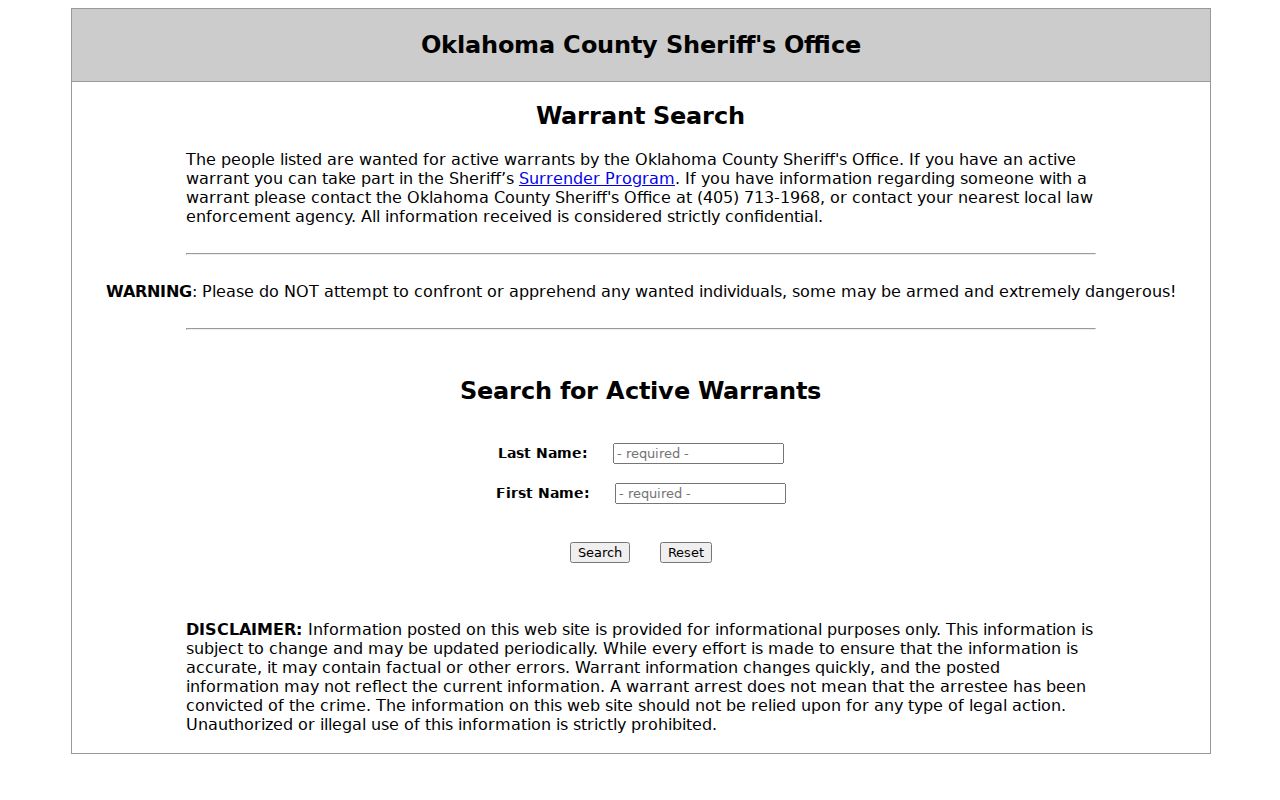
Work from the Oklahoma county or city where the case sits, then confirm with that clerk and the unit serving the paper. Note: A local sheriff list reflects one office's records, not every Oklahoma warrant from every court or city.
Oklahoma Warrant Roundups
No standing statewide roundup or amnesty program exists in Oklahoma, and no Oklahoma court runs one as a regular service. A clearing event, when a local court offers one, runs on set dates with eligibility set by that court and case. Before you pay an old balance or act on a notice, confirm current terms with the issuing court. The Oklahoma Attorney General's 10 Most Wanted campaign is something else entirely. Agencies nominate fugitive cases and the Attorney General picks which profiles to feature. It is a curated publicity program, not an active-warrant search, and staying off that list says nothing about whether an Oklahoma warrant exists.
Official program: The Oklahoma 10 Most Wanted page has current profiles. This page does not copy names or photos.
Its tip line is for campaign information, not personal status. Confirm an Oklahoma case with its court and serving agency.
A campaign list and a warrant record answer different questions. In Oklahoma, a roundup event, a fugitive profile, a public docket, and a sheriff search each cover separate ground, so check the one that fits your question.
The OAG Ten-Person Campaign Is Selective
Oklahoma's Attorney General opened a 10 Most Wanted campaign in September 2024, joining state, federal, tribal, and local partners. Agencies nominate cases, and the OAG picks which ones to feature, updating each profile as its case moves. That makes the campaign a spotlight, not a search tool. It is no roster and no way to rule out every Oklahoma warrant. Tips about the featured cases go to 405-343-8107 or OKMostWanted@oag.ok.gov; those channels take tips, not status questions. When a profile might involve you or a relative, take it straight to the Oklahoma court involved or to counsel. The OAG has reported 17 captures through May 14, 2026. That dated count tracks one campaign, not statewide outstanding warrants or county backlogs. No names, photos, or case details appear here, and any reward hinges on the official profile. An active warrant can sit with no profile at all, and a profile can change before separate court records catch up. Note: The campaign's dated capture total does not measure active warrants or county case clearances.
Finding Your Own Name on a List
If an Oklahoma public page might point to you or a relative, write down the court, case number, date, and warrant type before anything else. For an OAG profile, the official State Most Wanted page is the place to verify it. Ask the issuing clerk whether the order is still active, whether bond applies, and what appearance or motion it takes. Ask the sheriff or city police about service. Bring in counsel if identity or legal effect is unclear.
- Match the Oklahoma case number and court to the notice.
- Confirm status, bond terms, and next step with the clerk.
- Ask the serving agency about its record and requirements.
- Keep receipts or recall orders and ask who sends updates.
The Oklahoma court controls recall and appearance terms. Posting bond may win release without ending the case. For a traffic failure to appear, the court holds the warrant while Service Oklahoma keeps a separate license record. Fixing one does not clear the other.
Important: Confirm an Oklahoma warrant and safe surrender or bond terms with the issuing court and local agency before appearing or paying.
Confirm Oklahoma Active-Warrant Search Hits
Oklahoma docket records and sheriff records can disagree because different offices keep them. Check the case number and the court selector, then call the clerk; a municipal case may never surface in a district citation search. A restricted feed stays private, and a mismatch alone proves no office error. Request the court disposition from the clerk and a service return from the agency that serves papers. The Oklahoma Open Records Act, 51 O.S. §§24A.1 et seq., covers releasable law-enforcement dispositions under §24A.8, subject to exceptions. No statewide form, fee, or fixed response time applies, so a request is no substitute for urgent confirmation. OSCN and ODCR locate some dockets but not active status; Warrant Check explains the field limits. The county directory lists an Oklahoma clerk and sheriff, and a city citation can be traced to its Municipal Court and police channel. Name the custodian and ask for the disposition or the return rather than a broad list of names. Court files, sheriff service records, and municipal police records may need separate requests. A request can establish what the custodian recorded, but it cannot make restricted OLETS, ODIS, or NCIC data public or guarantee a real-time answer. Note: An Oklahoma public search cannot establish that every county and city record was checked.