
How Bench Warrants Work in Oklahoma
A bench warrant in Oklahoma is not the start of a criminal case. It is process inside one already pending, directing an officer to bring the defendant back before the court. That is the difference from an arrest warrant, which begins with a sworn complaint and a probable-cause finding. The legislature ties bench process to particular events, and the path varies with each one. A missed arraignment, a judgment setting, a city traffic appearance, or a court-ordered return may each follow its own route, and missed payment does not automatically become an arrest warrant. Pin down the exact order with the clerk. Oklahoma also runs two main court systems, District Courts and city Municipal Courts, with no general county justice-of-the-peace tier. A magistrate there is simply a judicial officer, not a separate court system.
Oklahoma Bench Warrants Begin in Existing Cases
In Oklahoma, a bench warrant lives inside a pending case. Title 22 §454 covers a bailed defendant who misses arraignment and may face both a warrant and bond forfeiture. Section 965 addresses failure to appear for judgment after conviction. Sections 455 and 966 cover the clerk's related process when court is not sitting.
- Failure to appear
- Missing a required event; the result depends on Oklahoma law, notice, and case type.
- Bench warrant
- Process in an existing case directing an officer to bring a defendant to court.
- Recall or quash
- A court action withdrawing process; confirm the serving agency received the update.
- Bond forfeiture
- A court action against security after a bonded defendant misses an appearance.
For an Oklahoma case, ask the District Court Clerk or the Municipal Court clerk for the order, the docket, and the next date. The sheriff or city police can confirm only its own service record. Note: Oklahoma court terms identify the process, but only the issuing judge can recall a particular order.
Bench Warrant Issuance in Oklahoma
Issuance in Oklahoma follows a set sequence. A judge or magistrate authorizes the process, the clerk prepares it and keeps the file, and a sheriff or peace officer serves eligible district process. Title 22 §§457–461 and 967–969 govern the forms, bail, service, and custody in particular settings. Title 22 §§459–460 also let specified district warrants be served in any Oklahoma county. Service elsewhere does not move the case or transfer recall authority, though; the issuing court keeps control of the order, and the receiving sheriff can explain execution or booking. Searching OSCN or ODCR may locate a docket event, but neither system confirms live warrant status. If the case does not appear, verify the court and case number on the original notice you received.
Oklahoma FTA Rules Shape Bench Warrants
Oklahoma has no single failure-to-appear rule; the statute, the notice, and the stage of the case all matter. Bail-related arraignment and post-conviction judgment take different paths, and an inability to pay may call for a hearing rather than automatic arrest. Title 22 §§454 and 965 offer examples. Under §1115.1A, some traffic FTA cases trigger a court process and a separate clerk report to Service Oklahoma, while parking and standing matters are excluded. A license suspension is not a warrant. Ask the issuing court about the order and Service Oklahoma about the license record. When you call, ask which event created the Oklahoma warrant and whether cost rules allow an ability-to-pay hearing or payment terms. Note: an Oklahoma traffic license hold and a court warrant are separate records, even when both began with one missed citation.
How Bench and Arrest Warrants Differ
Both kinds can authorize custody. But an Oklahoma bench warrant arises in an existing case, while an arrest warrant follows a sworn complaint and a probable-cause finding. Special cost warrants follow their own rules; the order and the underlying case control.
| Feature | Bench warrant | Arrest warrant | Cost warrant |
|---|---|---|---|
| Case stage | Existing Oklahoma court case. | Initial complaint process. | Specified cost or ability-to-pay process. |
| Legal event | Defined failure to appear or court event. | Complaint and probable-cause finding. | Notice or hearing steps under §983v3. |
| Who controls status | Issuing judge and clerk. | Issuing magistrate and clerk. | Issuing court under the cost-warrant statute. |
| What to confirm | Appearance date, bond, or recall. | Bailability, bond terms, and serving agency. | Hearing, report date, and form type. |
For the probable-cause side, see Arrest Warrant Lookup. In Oklahoma, a cost cite-and-release form directs the officer not to arrest solely under it, though later noncompliance may lead to a cost arrest warrant.
Oklahoma Cost Warrants Have a Hearing Path
Oklahoma separates cost arrest from cite-and-release through Title 22 §983v3 and the court's own forms. A person with covered costs, fines, fees, or assessments may request an ability-to-pay or willfulness hearing. The court weighs ability and may set terms or grant statutory relief. No fee applies to that hearing or to the cite-and-release form, and this narrow debt process is not bail relief for every bench warrant. The blank district cost arrest warrant form 13.17d shows the court and obligation fields that specific process uses.
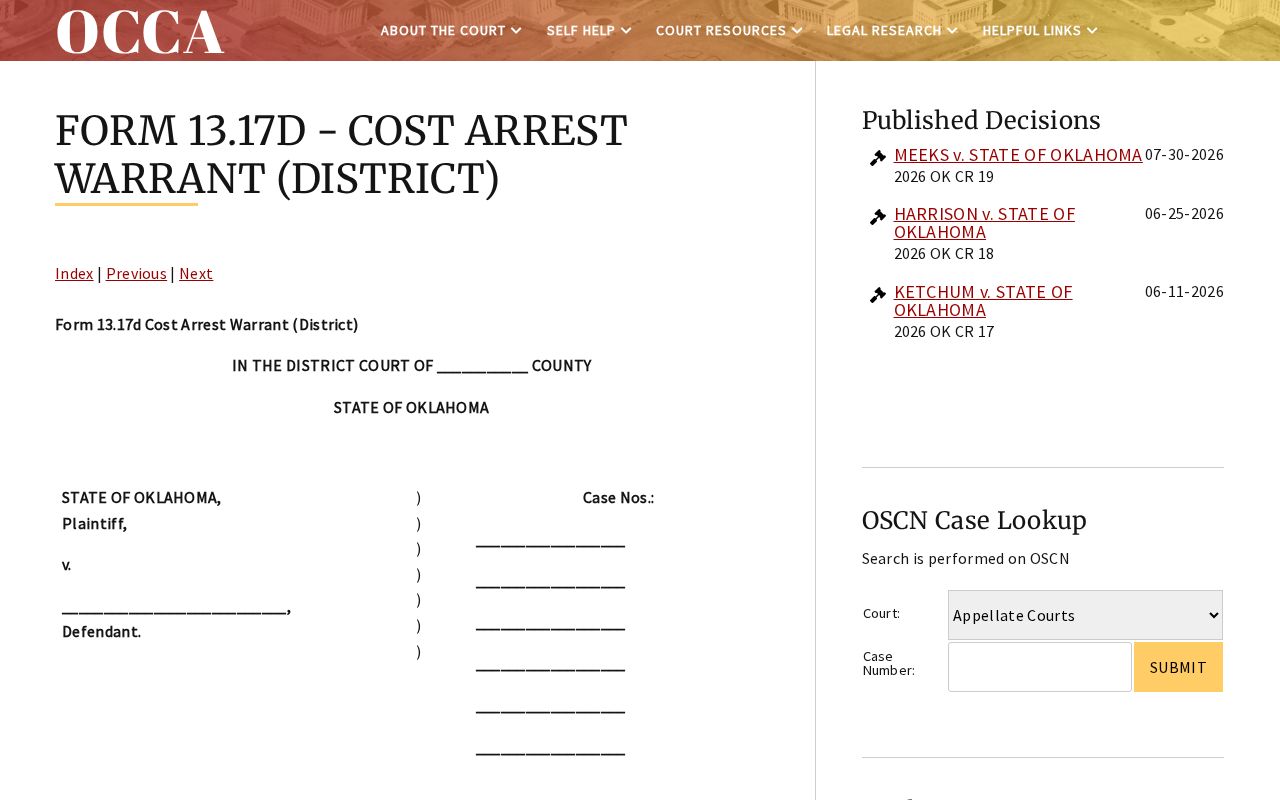
That form covers cost arrest only, not an ordinary arrest warrant or any universal bench process. The separate district cost cite-and-release form 13.17f orders a person to report to the clerk within the statutory period. It bars arrest solely under it, but failure to comply may lead to cost arrest process in Oklahoma.
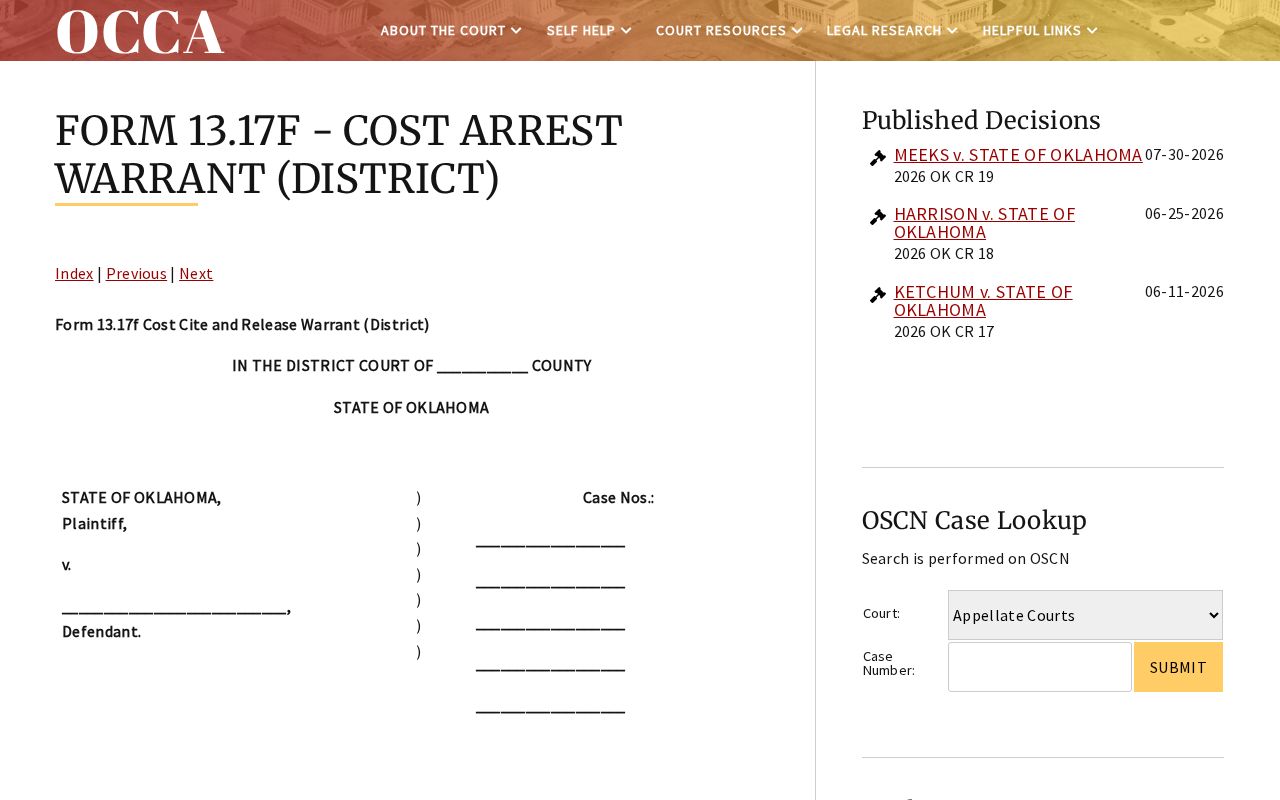
Some Oklahoma cost-arrest terms include a $100 option with a new hearing date or release on recognizance, subject to the statute and the facts. That is not standard bond. Confirm the current form with the clerk. Note: Confirm the Oklahoma court's current form and payment conditions before treating a cost-warrant example as applicable to the case.
Clearing a Bench Warrant in Oklahoma
To resolve an Oklahoma bench warrant, start with the basics: the court, the case number, the type, and the status. Ask the clerk whether the case needs a new date, bond, a motion, counsel, or a personal appearance. A cost case may allow a hearing or payment plan, and surrender arrangements should be confirmed before you travel.
- Ask the issuing clerk whether it remains active and why it issued.
- Confirm bailability, accepted bond, amount, and payment location.
- Ask whether recall needs counsel, a motion, hearing, or appearance.
- Obtain a receipt, court order, or written disposition.
- Ask whether the clerk notifies the sheriff or another agency.
Caution: An outstanding Oklahoma warrant may lead to arrest during law-enforcement contact; confirm court and surrender terms before appearing.
Bond may meet the release terms. The Oklahoma case itself stays open. Keep the receipt, ask the sheriff whether its record was updated, and for a traffic license hold ask Service Oklahoma once the court reports its action.
Confirm Surrender Terms Before Traveling
Oklahoma sets no statewide surrender policy. That goes for bond windows and recall forms too. Before you travel, ask the local court whether it accepts a scheduled surrender, an attorney appearance, or a walk-in, which office runs it, what papers to bring, and which bond is allowed. Hours posted by other courts do not apply. One county example is the Oklahoma County Sheriff's voluntary surrender page, whose In-and-Out process carries its own local eligibility and intake rules. It is not an Oklahoma statewide procedure. Its schedule and conditions can change, so the sheriff's page carries the current program information.
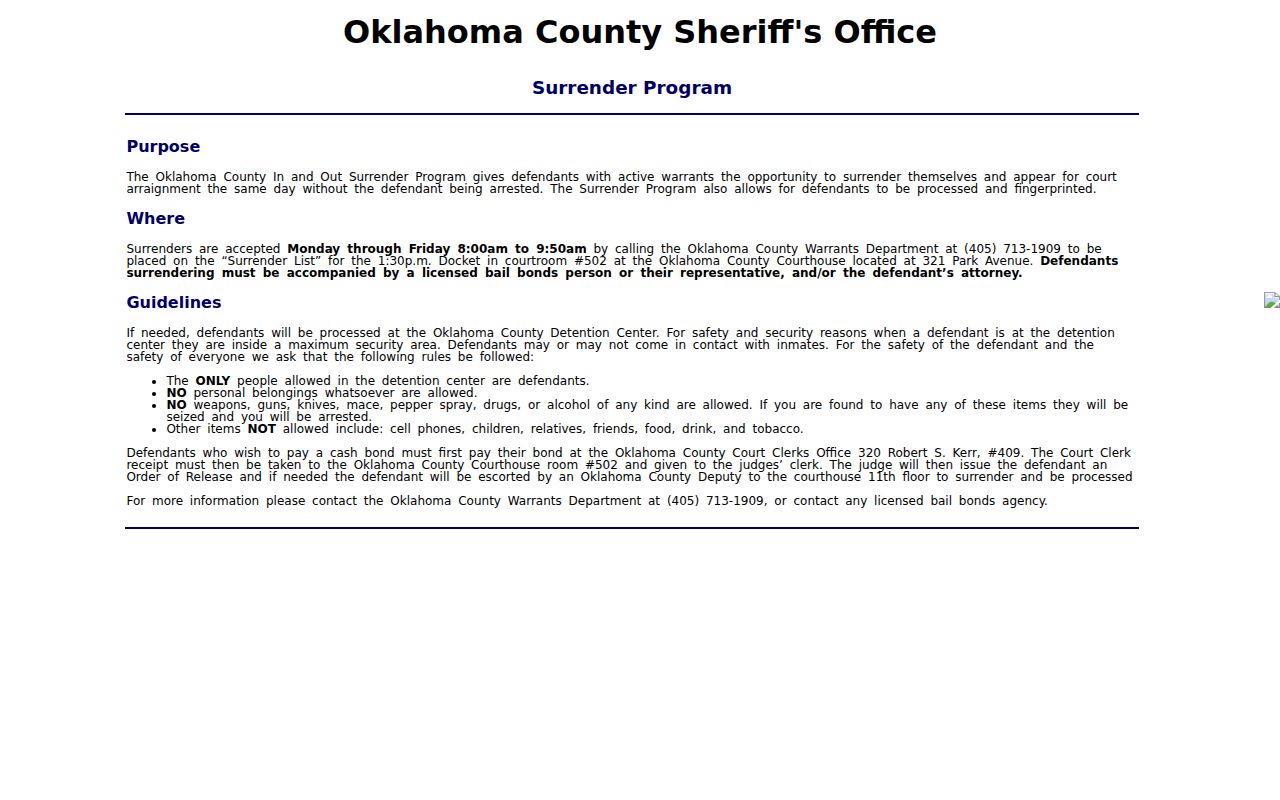
County rules vary, so confirm eligibility and logistics with Oklahoma court or sheriff staff before driving anywhere. The In-and-Out setup is one county's program. For other Oklahoma counties and cities, the county directory lists each District Court Clerk, sheriff, and Municipal Court. Check hours and bond forms with the office itself.
Oklahoma Courts That Issue Bench Warrants
Oklahoma District Courts handle felonies and general trial matters. The District Court Clerk confirms the order and the next court date, while the sheriff or an authorized officer handles service. Oklahoma has no statewide sheriff portal or phone line. City ordinance warrants belong to the issuing Municipal Court and its police. Oklahoma also skips a separate county JP tier, and it publishes no statewide warrant lookup. OSCN and ODCR can locate some District Court dockets, but neither is an Oklahoma warrant register. A magistrate's judicial role adds no extra court layer. If a case is missing, ask the named clerk which channel applies. Under Title 11, Municipal Courts handle city ordinance matters. Tulsa and Oklahoma City run local channels with distinct forms and timing, so a city warrant may not appear in a county sheriff or District Court search. OLETS, ODIS, and NCIC are restricted systems, not public bench-warrant tools. 47 O.S. §2-124.1 establishes the authorized OLETS identification feed, though subtype coverage and refresh times are not published. The Oklahoma Open Records Act, 51 O.S. §§24A.1 et seq., including §24A.8 may reach releasable law-enforcement dispositions. Send court-file questions to the clerk; route service requests to the agency. The state sets no statewide fee or response time. Note: An Oklahoma court clerk confirms the judicial order, while the sheriff or city police confirms its own service record.
Oklahoma Municipal Bench Warrants Stay Local
City warrants stay with the Municipal Court. Tulsa's police list can lag behind its workweek updates. Oklahoma City's lookup warns that new cases may take days to appear and that partial payment may not clear a warrant. Both are local examples, not Oklahoma statewide rules. Ask the city clerk or warrant unit about the order, the amount, any deadline, and how to appear. A payment page does not prove recall. Oklahoma District Court cases run through the county clerk and sheriff. Child-support contempt remains a District Court case, where a warrant may be requested after a properly served required appearance is missed, subject to the judge and the case. The state's contempt guidance explains the safeguards, and unpaid support alone does not create an arrest warrant.
Oklahoma Cost-Warrant Reforms Changed the Process
Oklahoma House Bill 2259 took effect November 1, 2023. HB 3546 changed related procedures on November 1, 2024. Some recall steps changed too. Ask the clerk which rule governs an older order. The first law set up a court-cost compliance path with separate cost-arrest and cite-and-release forms. The state legal update summarizes the amendments, but it is not a case record or a substitute for the current statute. A $5 clerk fee under 22 O.S. §§456A and 966A applies to certain bench warrants for unpaid costs, fines, or fees. Not every warrant qualifies. Sections 1101 and 1105 set bailability rules and allow district schedules within limits. Municipal sheriff service fees fall on the city, not the defendant. Confirm the balance with the clerk. "Capias pro fine" is not Oklahoma's statewide label. Keep the local court's wording, and ask what process it means. Note: Oklahoma's cost-warrant forms and fees apply only to specified court-debt cases, not every missed appearance.