
Oklahoma Warrant Checks
Start an Oklahoma warrant check with the court and city named on the citation, summons, or notice. OSCN and ODCR may locate participating dockets. Sheriff and city searches cover only their own records. Ask the District Court Clerk or Municipal Court clerk about the order, and the serving agency about its status.
- Read the notice or case paper and note the county or city, court, and case or citation number. A city ordinance ticket belongs to Municipal Court even when the person lives in another county.
- Search the Oklahoma State Courts Network docket if the court's records appear there. For participating non-OSCN courts, follow OSCN's link to ODCR. Neither docket search is a current warrant-status guarantee.
- Open the relevant county sheriff's official site or call its warrant division. Some sheriffs provide name search forms; others use phone, walk-in, or record-request channels. No shared state portal joins those lists.
- For a city ticket, check that Municipal Court and its police or warrant office. Municipal records are not a general county docket tier, and OSCN's traffic-citation search excludes municipal citations.
- Ask the clerk and serving agency whether the warrant is active, what court issued it, and what bond or appearance is required. For a document, send a narrow request under the Oklahoma Open Records Act to the office that keeps it.
Use the county directory next. It links the court and sheriff for your venue. If a warrant may affect your case or a relative's, an Oklahoma attorney can explain options before any call, payment, or appearance.
Oklahoma Has No Public Statewide Warrant Search
No Oklahoma agency offers the public one search by name or date of birth covering every county and city. Each office keeps its own warrant records. The statewide data route serves authorized law-enforcement users under state law. It offers no public lookup form and publishes no completeness report.
A result or no result in OSCN, ODCR, a sheriff search, or a curated fugitive program does not confirm that a warrant exists or does not exist. Confirm status with the court that issued the process and the agency responsible for service.
Note: A case filed in another county or city can sit outside the venue you checked, even when a different Oklahoma source returns nothing.
Oklahoma Dockets and Warrant Status Differ
OSCN and ODCR are court-record tools, not active-warrant registries. OSCN searches participating court dockets. ODCR, linked by OSCN for records outside that system, covers courts that join its service. Scope varies by county and court, and a docket event may not show whether an officer's warrant copy is still active.
| Channel | What It Can Show | Limit |
|---|---|---|
| OSCN | Available case events and court filings | Participating docket data, not live warrant status |
| ODCR | Records from participating non-OSCN courts | Coverage changes; not a complete statewide warrant list |
| County sheriff | That agency's own search or service information | No single statewide form or common update schedule |
| Municipal Court | City-ordinance case and local warrant information | Separate from county District Court records |
The OSCN search form offers fields for county or court, case number, party names, date ranges, and some citation information. Its traffic citation notice does not cover municipal citations. A docket match identifies the case to ask about. It gives no statewide warrant number, bond, or service result. The official Oklahoma court docket landing page shows where public docket searches begin. That helps when you know the venue. Still, a docket screen is only one part of an Oklahoma warrant check.
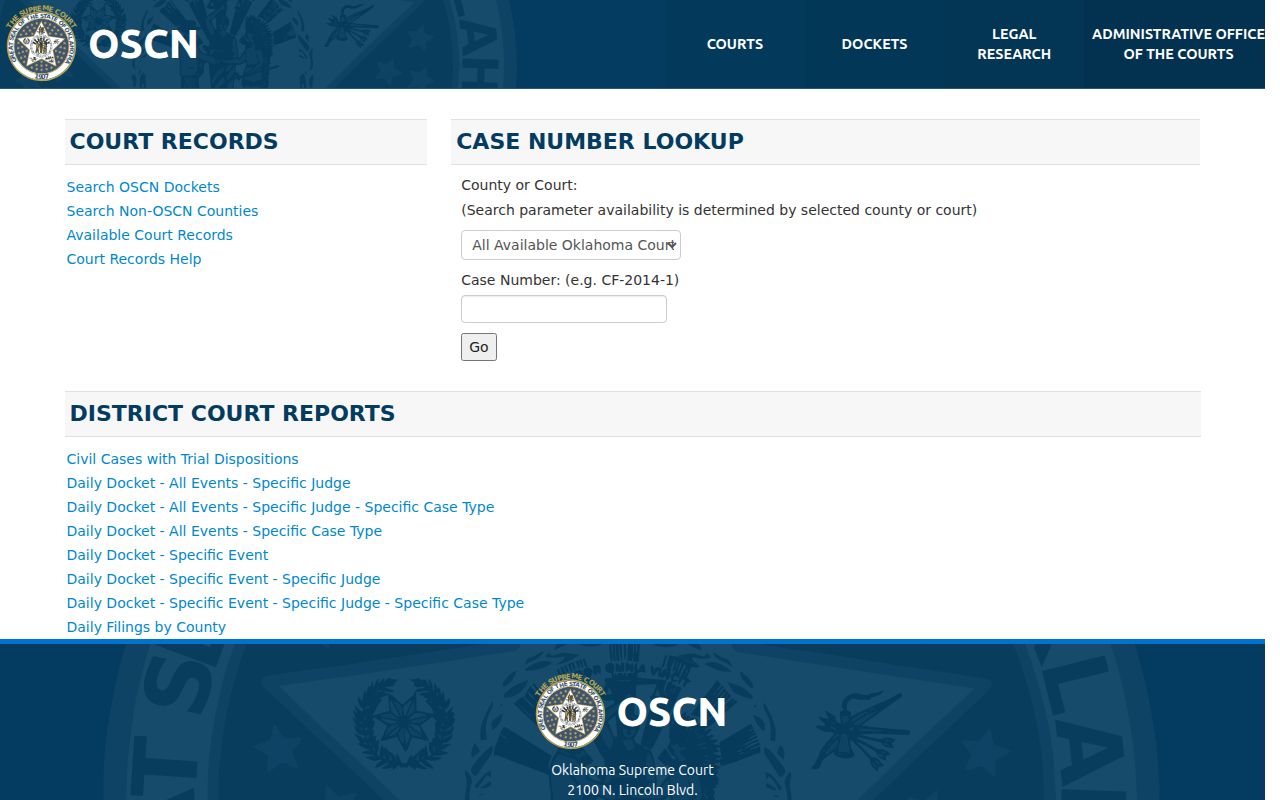
The landing page itself lists no person's case result. It is only a starting point. The issuing clerk and sheriff remain the contacts for warrant status and service in Oklahoma.
Oklahoma's Statewide Warrant System
Oklahoma's statewide warrant channel is law-enforcement only. Under 47 O.S. §2-124.1, the Office of the Administrative Director of the Courts provides DPS with current computerized arrest-warrant identification information for dissemination to OLETS users. The statute builds a statewide flow of identification data. It creates no public all-warrant register. Nothing in it lists which warrant types or local sources feed the channel, the record-level refresh time, or the fields an authorized user sees. Municipal, cost, civil, and support process may not appear. Do not assume otherwise. Public dockets, local sheriff lists, and the OAG Most Wanted campaign are separate sources with different scope. The Oklahoma warrant database overview explains the DPS, OSBI, federal, and court systems in more detail. Use it for context. For a warrant touching your own case, the county sheriff and issuing court remain the local route for status and resolution in Oklahoma.
Oklahoma OLETS Sends Restricted Data
DPS runs OLETS as a communications network for authorized public-safety and criminal-justice users. It connects criminal-history, driver, and other systems. Under §2-124.1, the courts' administrative office supplies current arrest-warrant identification data for OLETS dissemination. No public search opens through it in Oklahoma.
Oklahoma Department of Public Safety
Operates OLETS and coordinates authorized state and interstate network access. It does not confirm a member of the public's warrant status.
Oklahoma State Bureau of Investigation
Runs ODIS records-management functions and the state's NCIC communications role for criminal-justice agencies. Public name search is not available.
OSBI's ODIS system and OLETS are distinct things. ODIS is an agency records-management system with warrant and citation modules. NCIC is a restricted network. Neither is a consumer lookup. The statute calls the identification data current, and OLETS is described as real-time, but that does not mean each Oklahoma court feed updates in real time. Note: a qualifying record in the restricted OLETS channel may not appear in OSCN, ODCR, or a local Oklahoma sheriff's public search.
Warrants in Oklahoma: The Main Types
Oklahoma warrant records can reflect several court actions. An arrest warrant follows a sworn complaint and a probable-cause finding, while a bench warrant arises in a pending matter when a statute or court order allows that response. Municipal ordinance warrants belong to the city's court. Search warrants authorize a search, not a person's arrest by definition.
| Process | How It Arises | Issuing Venue |
|---|---|---|
| Arrest warrant | Sworn complaint and probable cause | Magistrate under Title 22 |
| Bench warrant | Specified event in an existing case | Judge or magistrate as authorized |
| Municipal warrant | City-ordinance case or municipal traffic matter | Municipal Court under Title 11 |
| Cost arrest warrant | Defined court-cost and ability-to-pay process | District or municipal court |
| Cost cite-and-release | Covered cost matter requiring a report to the clerk | District or municipal court |
| Search warrant | Judicial authority to search listed places or items | Issuing magistrate or court |
These categories share no single status field or remedy. Federal warrants follow federal process. Oklahoma statutes and official forms use terms like arrest warrant, bench warrant, cost arrest warrant, and cost cite-and-release warrant. “Capias” is not the general statewide name, so keep the words on the actual court record.
Oklahoma Cost Process Has Two Forms
A cost warrant is not the same tool as an ordinary arrest warrant. Oklahoma builds this path from Title 22 §983v3 plus the Oklahoma Court of Criminal Appeals mandatory Forms 13.17d through 13.17g, which lay out an ability-to-pay and compliance route for specified court obligations. The court may weigh what a person can pay. It can then set conditions under the statute.
| Cost Process | What the Official Form Shows | Arrest Consequence |
|---|---|---|
| Cost arrest warrant | Order, cost matter, service, hearing or release terms | Custody may follow under the specific statute and order |
| Cost cite-and-release warrant | Notice to report to the clerk and resolve the cost matter | Officer must not arrest solely under this form |
Oklahoma's cost arrest process comes in two forms. A cite-and-release form does not by itself put a person in custody, and the cost arrest process carries its own conditions. Ask the clerk which one applies.
Oklahoma Courts Cross County Lines
Oklahoma spreads its 77 counties across 26 judicial districts. One district can cover several counties. Every county still gets its own District Court and District Court Clerk, while Municipal Courts handle city-ordinance matters as a separate local venue. Read the court level on any notice carefully. It matters more than where a person lives. The FY25 court report logged 415,738 District Court filings and 163,463,919 OSCN docket searches, along with 352 municipal courts not of record and two municipal criminal courts of record. Those numbers measure court workload and portal traffic, not warrant totals or unique people. They also say nothing about which courts publish warrant data. For layout, the official court map shows how districts and counties fit together, though it cannot reveal whether a particular warrant remains active. District cases live with the District Court Clerk, who keeps the file, while the sheriff or another authorized peace officer handles service. A city ticket can stay with the Municipal Court and local police. Oklahoma has no general statewide justice-of-the-peace court network, so treat "magistrate" as a role, not a separate countywide court tier. Note: Judicial district boundaries map the trial-court structure, not which agency holds a warrant's service copy.
Oklahoma Warrant Records: What They Show
Oklahoma publishes no statewide sample warrant record and no uniform warrant-number format. The statutes spell out the parts of an ordinary written warrant, and blank cost forms show the fields that limited process uses. Beyond that, a county search result may be nothing more than a name match, and a docket may list the case and its court events while staying silent on service status.
| Warrant number | No uniform public format was found. Use the case or citation number to ask the custodian. |
|---|---|
| Person and offense | Ordinary process identifies the accused, if known, and the alleged offense under Title 22. |
| Issuing court | The District Court or Municipal Court that authorized the specific process controls its case file. |
| Bond or appearance | Terms depend on the order, the offense, and whether the warrant is bailable. |
| Status | Issued, served, returned, recalled, or quashed may be held in separate court and agency records. |
Title 22 §§172–173 lay out the core elements of a written warrant in Oklahoma: the magistrate's signature, the accused's name or a description when identity is unknown, the offense, the time and place of issue, and a bail endorsement where one applies. No public screen promises to display every field. A missing number or status label never proves the case is gone.
Oklahoma Docket Hits Do Not Prove Status
A docket hit on a public portal proves nothing by itself about an Oklahoma warrant. The entry will not show whether the warrant is active, served, or recalled. Names can match different people, and portals do not promise uniform fields for warrant number, issuing judge, bond, or status.
Use a docket hit to find the court and case number, then ask the District Court Clerk or municipal clerk for the recorded order. Contact the sheriff or city warrant office about service, custody, or its own operational copy.
A no-hit result gets the same caution. The record may sit in a city court, a county outside the portal's coverage, a restricted law-enforcement system, or a sealed file. Oklahoma readers should confirm the right venue before assuming a warrant has been cleared.
Oklahoma Warrant Terms Need Context
Oklahoma's public systems share no common codebook for warrant status. The wording on a court's own record controls. Ask the clerk how a term applies to the case and whether the sheriff's record has been updated.
- Bench warrant
- Court process in a pending case that directs a person to be brought before the court.
- Cost arrest warrant
- A defined court-cost process under Title 22, with an ability-to-pay and hearing path.
- Cost cite-and-release
- A cost form that directs reporting to the clerk and does not authorize arrest by itself.
- Recalled or quashed
- A court has withdrawn or set aside the order; ask whether the serving agency also received notice.
- Warrant return
- An officer's report to the court about execution or nonexecution of process.
"Active" and "outstanding" are local status terms, not a guaranteed statewide field. A case marked disposed may still need a separate warrant update. "Capias" shows up in individual records, but Oklahoma uses no single general label. Note: Quote the court's exact term when asking a clerk to explain a warrant's status, return, or remaining action.
Warrant Record Access Under Oklahoma Law
Oklahoma's Open Records Act, 51 O.S. §§24A.1 et seq., opens most government records to the public within statutory limits. Ask the right office for what you need. The District Court Clerk keeps court files, a municipal clerk holds city cases, and the sheriff or police department maintains its own service and disposition records. The Act requires prompt, reasonable access. Oklahoma sets no fixed number of response days, though, and no uniform fee for warrant copies across the state.
Oklahoma access rules
51 O.S. §24A.5 sets the general public-record rule, subject to statutory exceptions.
51 O.S. §24A.8 addresses law-enforcement records, including disposition of warrants maintained by an agency.
10A O.S. §1-6-102 makes juvenile records confidential except where law allows disclosure.
22 O.S. §385 protects grand-jury matters until the events stated in the statute.
That does not make every active warrant secret. An office may withhold investigative material, sealed records, juvenile information, or protected personal data. A narrow request for a warrant disposition often works better than a sweep for everything on one person. For current status, call the issuing court and the serving agency in Oklahoma directly.
Oklahoma Traffic FTA Creates Two Records
Miss a covered traffic appearance in Oklahoma and two records can follow: a court warrant and a separate driver-privilege action. They are not the same thing. Under 22 O.S. §§1115.1A and 1115.5, the clerk reports the failure to appear to Service Oklahoma in the specified cases. That report drives the license suspension, not the warrant itself. Title 47 §6-212 sets a $25 processing fee and a separate $25 reinstatement fee. Neither amount is your court balance, your bond, or an all-in total. Start with the ticket. Confirm what the issuing District or Municipal Court wants, then use Service Oklahoma's official suspension and reinstatement guidance for the license side. No public statewide warrant or driver's-license number search covers these records. The restricted court reporting tool moves compliance data between authorized users only. Ask the clerk whether a clearance went out, then ask Service Oklahoma what reinstatement still requires. The Oklahoma traffic warrant page walks through that separate sequence in more detail.
Resolve an Oklahoma Warrant and Verify
Before paying anything or driving anywhere, confirm the order with the issuing court. A public result in your case or a relative's case is a lead, not a final answer. Oklahoma has no statewide surrender schedule, bond window, or warrant-amnesty program. Dates, payment methods, and appearance rules come from the court that issued the warrant.
- Call the clerk to confirm the warrant type, active status, case number, and next court requirement.
- Ask the sheriff or municipal warrant unit about service status, accepted bond, and any surrender arrangement before going in person.
- For court costs, ask whether the Title 22 ability-to-pay hearing or payment terms apply to the specific cost process.
- Get a written court order or receipt and ask which office will send the recall or compliance notice to the other record holder.
- Check again with the court, serving agency, and Service Oklahoma when separate driver-privilege records are involved.
Oklahoma's verbal-warning option for certain misdemeanor encounters under §§177 and 185 is officer discretion in the moment. It is not an advance appointment or an automatic recall. The 2026 Oklahoma City penalty program and past county or Tulsa clearing events were local and date-limited. Don't wait on an event. Don't borrow another county's schedule. Verify current terms with the specific court. Note: Keep the court order or receipt, and ask which agency received the update before assuming the warrant record changed everywhere.
Warrant Records by County in Oklahoma
Oklahoma has 77 county sheriffs and 77 county District Court Clerk offices. There is no shared warrant portal. District-court warrants and case files get confirmed locally. Municipal warrants may sit with the city court and police instead. These featured county pages offer a starting route in major population centers, though the court named on the case still controls its process.
Oklahoma County
Oklahoma City · The state's largest county; the sheriff publishes a local warrant search and eligibility-limited surrender option.
Tulsa County
Tulsa · The City of Tulsa name search covers municipal warrants, separate from District Court cases.
Cleveland County
Norman · Norman municipal matters and county District Court cases use separate venues.
Canadian County
El Reno · Oklahoma City metro county; the county court and sheriff remain the route for its process.
Comanche County
Lawton · City ordinance tickets and Comanche County District Court process are separate.
Rogers County
Claremore · Tulsa metro county with its own court and sheriff channels.
The population figures come from 2020 Census counts. Oklahoma County leads at 796,292, then Tulsa County at 669,279, Cleveland County at 295,528, Canadian County at 154,405, Comanche County at 124,098, and Rogers County at 95,240. Want a different county? Browse the full directory of all 77 Oklahoma counties to open the county route for the court or sheriff on a case notice.